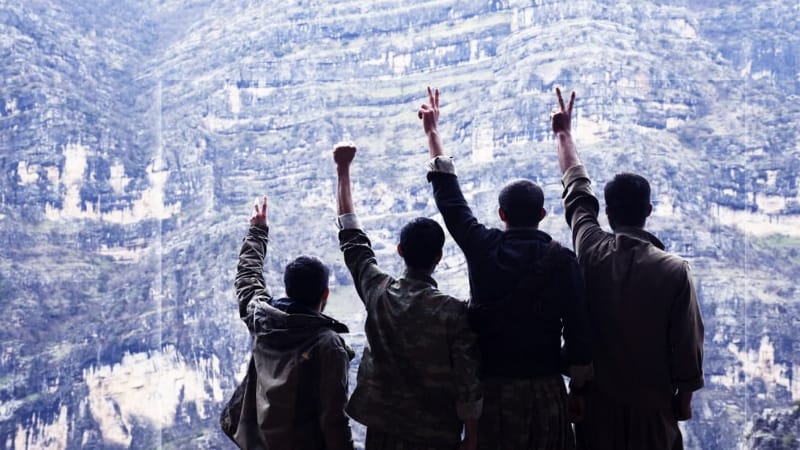
This revolutionary move, exercised under conditions and relentless war in the Medya Defense Zones, marks a new moment for the guerilla of the Kurdish liberation movement, proving its ability to turn the situation in its favor and establish advantage in the ongoing war. With its tremendous revolutionary war effort in Zap and Xakurkê, it proved the oppressed people’s determination to fight, their strength, their courage, and their limitless creative action. It raised the hope of the oppressed who are ready to fight against fascism. The term General Winter first arose in the context of war and politics during Napoleon’s invasion of Russia. In 1812, the French emperor’s army invaded Russia with a force of six hundred thousand men. Napoleon, however, failed to take one critical factor into account: the winter season. And thus, his ambitions to invade Russia ultimately resulted historic defeat. What remained of his huge army was a force of thirty to forty thousand people. Not Russia’s Tsarist army, but the cold winter destroyed Napoleon’s units. British humorists, observing the war from their imperial lodge, described the situation as “General Winter shaving the skinny shorty.” Since then, General Winter has been established as a special term in military history. It serves as an explanatory and analytical term of the relationship between nature and war conditions. General Winter is a factor that can determine the outcome of wars at different times and in different geographies. Enver Pasha, blind in terms of military strategy and unable to recognize frosty conditions, led a hundred thousand imperial Ottoman soldiers into the war against Russian tsarism towards the Caucasus. There the conditions of General Winter mowed down a huge army in the Allahuekber mountain range. Ninety thousand Ottoman army soldiers froze to death. This event has since been engraved in the collective memory of the Turkish people as a great social trauma. General Winter also paralyzed the largest army under the Nazi regime. During the Second World War, General Winter once again played a key role in defeating of the Nazi war machine at Stalingrad. The Soviet Red Army and partisans, on the other hand, endured winter conditions, paving the way for a historic defeat Nazi Germany. Natural conditions are among the factors that affect and determine the course war, not only in symmetrical wars waged by regular armies among states, but also in guerrilla wars against colonial occupation states. The army that “cooperates” best with the geographical and seasonal conditions, that is, General Winter, swamps, jungles or deserts, wins the war. Guerrilla wars are full of countless data and experiences of utilizing the power of nature in the highest and most creative way. In this unequal war of David against Goliath, the people’s guerrilla forces have managed to make maximum and creative use of their environment in technical and tactical terms. Guerilla movements have historically achieved strategic and tactical success by relying on nature and using it as a tool against their enemies. Looking through the mirror of 20th century guerrilla wars, reveals that natural conditions are decisive and characteristic aspects of guerrilla warfare. The Vietcong’s defeat of the US army in the swamps of Vietnam is an example of the harmony and mutual reinforcement of natural conditions and the Vietcong guerrillas. Another such example are the FARC and MLN guerrillas of the Colombian jungles, which they turned into effective trenches and shelters, stopping and striking the regular army of Colombia, and establishing liberated zones. The presence of the New People’s Army, led by the Communist Party of the Philippines, in the jungles of the Philippines also embodies a similar reality. In short: mountains, jungles, forests, swamps, deserts can be turned into free areas in the guerrilla wars of the oppressed against their oppressors. With other favorable conditions of nature, regular armies can be destroyed and victory can be achieved through the creative ingenuity of guerrilla warfare. In many of the social and national liberation revolutions of the 20th century, guerrilla armies realized fruitful experiences of the reality of nature and war. Historical and current experiments show us again and again that this stands as a valid fact. The guerrilla wars of the Middle East in Palestine and Kurdistan are proponents of this truth. Whether we look at the urban guerrillas in the tunnels of Gaza, or at the Kurdish guerillas fighting for their liberation attacking the colonial army from their shelters and tunnels in the heart of the Kurdish mountains— the lesson we can learn from them is that any battlefield and condition can be overcome using creative revolutionary techniques and tactics, thus inflicting defeat on colonial armies. The colonialist fascist Turkish bourgeois state suffered a heavy and strategically important military blow in the Medya Defense Areas in Bashur (Southern Kurdistan). Between December 22 and 23, HPG and YJA–Star guerrillas attacked the military bases of the colonialist Turkish army in the Zap and Xakurkê regions. The Turkish forces were surrounded and shot by Kurdish guerrilla fighters from four different branches in the Zap region. In Xakurke, the colonialist Turkish bourgeois army was blockaded from eight points and its forces were destroyed. According to statements issued by the HPG–BİM, 52 Turkish bourgeois army soldiers were killed. The realization of these revolutionary tactical moves was facilitated by General Winter‘s provision of sufficient favorable conditions and the guerrilla’s strong preparation, creative tactics and skillful execution ability. It has been confirmed that the Turkish army’s advantage over the guerrillas waded, resulting in its defeat, when it could not receive SİHA, UAV and F-16 (drone and aircraft systems utilized by Turkish military) support during winter. Usually conducting short-term military operations in winter conditions, the colonialist Turkish bourgeois army declared a strategy of staying in occupation bases in the Medya Defense Areas during the winter months, in an attempt to implement the strategy of becoming permanent by holding colonial occupation bases and thus immobilizing the guerrilla. Instead, however, this strategy left the colonial army weak and defenseless, deprived of instant UAV, UCAV and F-16 support in winter conditions. The revolutionary operations of the Kurdish guerilla in Xakurkê and Zap dealt a blow to this weak underbelly of the colonialist Turkish bourgeois army. Coming from beneath the mountains through tunnels and shelters, crushing the fascist enemy, like a hurricane rushing over the mountain. The guerilla, having established its military tactics in harmony with all fours seasons and all natural conditions, aware of all the possibilities and limits of nature and geography won a very important victory of a strategic nature. This revolutionary move, exercised under conditions and relentless war in the Medya Defense Zones, marks a new moment for the guerilla of the Kurdish liberation movement, proving its ability to turn the situation in its favor and establish advantage in the ongoing war. With its tremendous revolutionary war effort in Zap and Xakurkê, it proved the oppressed people’s determination to fight, their strength, their courage, and their limitless creative action. It raised the hope of the oppressed who are ready to fight against fascism. It uplifted the the resistance raised in the prisons against the absolute isolation of İmralı with the energy of the guerilla, sharpening the accumulated anger of the oppressed against the fascist regime and increasing their willingness and courage to carry on and amplify the struggle. To hide its defeat and the blow it suffered in the Medya Defense Zones from the Turkish people, the political Islamist fascist regime retaliated by bombing Rojava. The war crimes of a desperate colonialst Turkish state rained down on the civil infrastructure in Rojava. And, once again, it massacred civilians in the process. Erdoğan implements warfare informed by the pain and despair of defeat in Bashur. It attacks the DEM Party (successor of the HDP) and Kurdish democratic institutions with arrest waves, fuels Turkish chauvinism, and organizes fascist lynchings. All the while it destroys the infrastructure of Rojava relentlessly. Just like Israel did in Gaza and all of Palestine, it is trying to make social life unbearable in Rojava, dissolve the political structure, and eliminate its status step by step. Turkish colonialism uses all its war capacity, including chemical weapons, to its limits. Despite this, it is strategically unable defeat the Kurdish freedom struggle and cannot move forward. On the contrary, it is suffering tactical defeats and heavy losses at hands of the guerilla forces. He weakens by losing initiative, power and position. The guerrilla’s of Xakurkê and Zap, on the other hand, move magnified the dilemmas of the colonial regime. It showed that its crisis of rule would deepen. CHP’s attitude after the Bashur defeat revealed an important rift between the collaborator Turkish ruling classes regarding the course of the colonial war. Our laboring left movement should never remain indifferent to the given situation. The message of resistance and struggle that the Kurdish guerilla gives to our people must be understood correctly. Concepts that will reverse the chauvinist campaigns of the fascists must be actively developed, and the revolutionary struggle of the oppressed must be advanced through a united and legitimate struggle. *Editorial of the 148th issue of ATILIM newspaper, Voice of the Working Class and the Oppressed, dated December 29.